
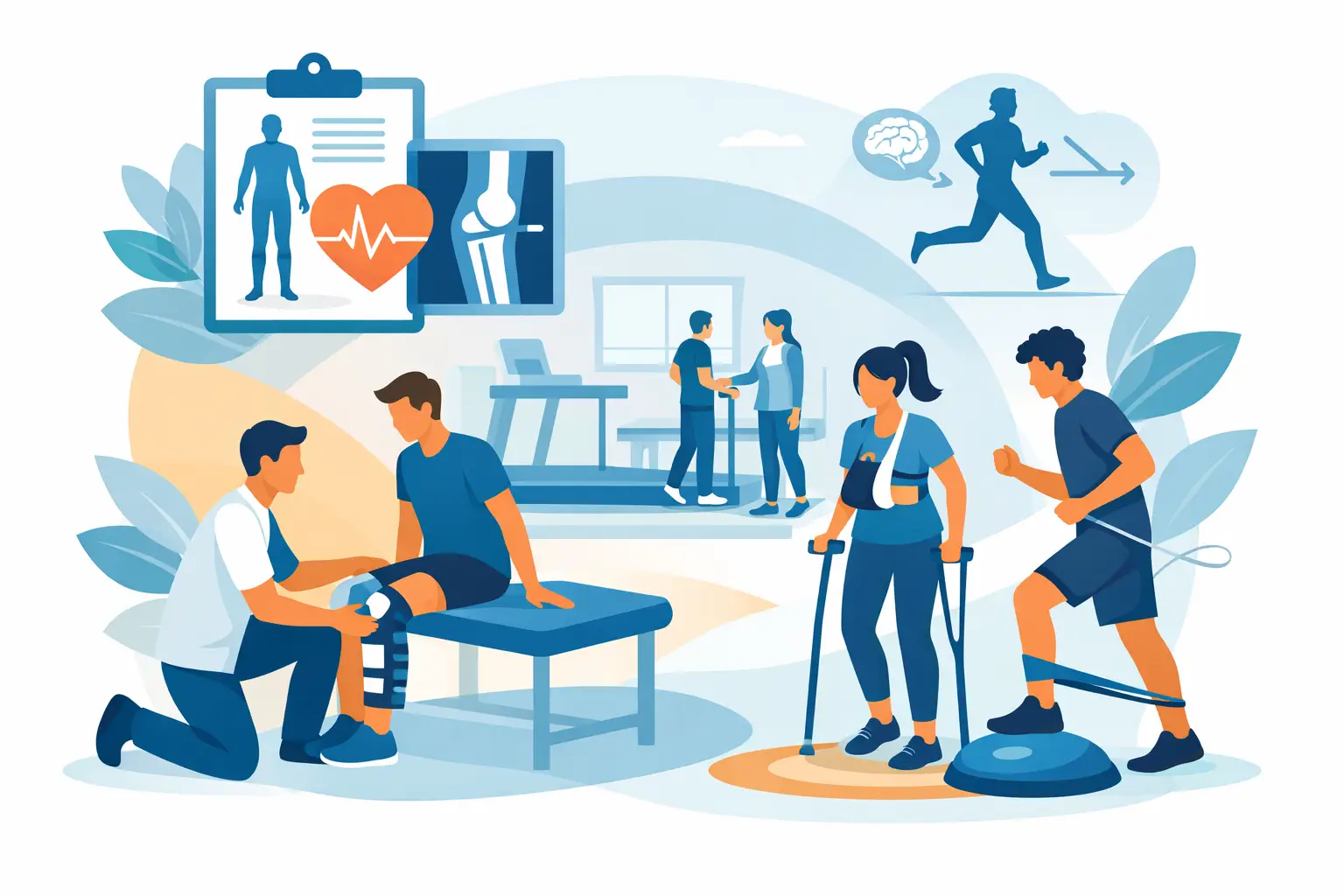
The first week after an injury often feels like guesswork. Pain changes by the day, movement feels unreliable, and advice from friends, trainers, and search results rarely lines up. A good guide to injury rehabilitation should make one thing clear from the start – recovery is not just about waiting for pain to fade. It is about helping tissue heal, restoring mobility and strength, and fixing the movement problems that may have contributed to the injury in the first place.
That matters whether you are dealing with a sprained ankle, low back strain, shoulder irritation, whiplash, or a nagging overuse issue that has been building for months. The right plan can shorten downtime, reduce setbacks, and improve the way your body handles daily life long after symptoms calm down.
What injury rehabilitation is really trying to do
Rehabilitation is not a single treatment or a set timeline. It is a process that helps your body move from pain and protection back to normal function. In some cases, that means getting back to work without stiffness by the end of the day. In others, it means returning to the gym, the golf course, or weekend sports without the same injury coming back.
A common mistake is treating rehab like a race. People often stop as soon as pain drops, even though strength, balance, coordination, and joint control have not fully returned. That is one reason re-injury happens so often. Tissues may be less irritated, but the body still is not moving well under load.
Good rehabilitation also looks beyond the site of pain. A sore knee may involve hip weakness. A recurring neck issue may be tied to posture, stress, sleep position, or thoracic stiffness. A foot problem may change the way the whole leg absorbs force. When care only chases symptoms, progress tends to be temporary.
A guide to injury rehabilitation by recovery stage
Most injuries do not follow a perfect timeline, but rehab usually moves through recognizable stages. The details depend on the injury, your health history, and how physically demanding your routine is.
Stage 1 – Calm the irritation
In the early phase, the priority is to reduce aggravation and protect the injured area without complete shutdown. Rest has a role, but too much rest can create a new problem. Muscles weaken, joints stiffen, and the nervous system becomes more sensitive to movement.
This stage usually focuses on reducing pain, controlling inflammation when present, and maintaining whatever safe movement is available. Hands-on care, gentle mobility work, soft tissue treatment, and therapies such as acupuncture, cold laser therapy, or shockwave may be considered depending on the injury and the clinical findings. The goal is not to throw every treatment at the problem. It is to use the right tools at the right time.
Stage 2 – Restore movement
Once the injury is less reactive, the next job is getting movement back. This may sound simple, but it is where many people get stuck. If an ankle still lacks mobility, the calf stays tight, or the shoulder blade is not moving properly, the body starts compensating.
Restoring motion involves more than stretching a sore area. It often includes joint mobility, tissue work, controlled range of motion drills, and reintroducing movements that feel safe and repeatable. This phase should challenge the body without provoking a major flare-up. Mild soreness can be normal. Sharp pain, worsening swelling, or lasting setbacks usually mean the plan needs adjustment.
Stage 3 – Rebuild strength and control
When movement improves, the body needs to relearn how to handle force. This is where exercise becomes central. The exact program depends on the tissue involved, but the principle stays the same – strength protects recovery.
Rehab exercises should be specific enough to address the injury and practical enough to fit real life. A desk worker recovering from neck and shoulder pain needs a different progression than a runner recovering from Achilles pain. Both need control, endurance, and load tolerance, but the way those qualities are trained will differ.
This is also where coordination and balance matter. If the body cannot stabilize well, even a strong muscle may not perform when it counts. That is why rehabilitation often includes simple but targeted drills that train timing, control, and confidence, not just brute strength.
Stage 4 – Return to activity
The final phase is not just doing your old routine and hoping for the best. Return to activity should be gradual and measured. If you play sports, that may mean rebuilding speed, cutting, jumping, or rotational power. If your job is physical, it may mean tolerating lifting, carrying, climbing, or prolonged standing without a delayed pain spike.
This stage is where a lot of hidden gaps show up. You may feel fine walking, but not when changing direction. You may tolerate light workouts, but not repeated overhead lifting. A complete rehab plan tests those demands before you are fully back to them.
Why treatment works better when it is integrated
A strong guide to injury rehabilitation should include a simple truth: one method rarely solves every part of recovery. Exercise is essential, but some patients also need hands-on care to improve joint motion, reduce muscle guarding, or make exercise more tolerable. Others benefit from therapies that help calm pain enough to start moving again.
An integrated approach can be especially useful for complex or stubborn cases. Chiropractic care may help restore joint mechanics. Massage therapy can address soft tissue tension and improve comfort. Acupuncture may support pain relief and muscle relaxation. Shockwave therapy can be helpful for certain chronic tendon issues. Custom orthotics may improve loading patterns for some foot, knee, or hip problems.
The key is matching treatment to the problem instead of applying a generic formula. Not every injury needs every service. What matters is having a plan that connects symptom relief with functional progress.
The most common mistakes that slow recovery
Some setbacks happen because the original injury was severe. Many others happen because the recovery plan was incomplete or rushed. One common mistake is waiting too long to get assessed, especially when pain keeps returning or movement feels limited weeks later. Another is using pain as the only benchmark for progress.
People also run into trouble when they do too much too soon. Feeling 70 percent better can create false confidence. You test the injury with a hard workout, a long shift, or a weekend tournament, and symptoms come right back. That does not always mean you have re-injured the area, but it often means the tissue was not ready for that level of demand.
There is also the opposite problem – doing too little for too long. Protective movement patterns can stick around after the tissue has begun healing. Without guided progression, stiffness and weakness can outlast the injury itself.
When to get professional help
Some minor strains improve quickly with relative rest and gradual movement. Others need a more structured plan. If pain is sharp, severe, or worsening, if you have swelling that does not improve, numbness, obvious weakness, instability, or trouble bearing weight, it is smart to get evaluated sooner rather than later.
You should also seek help if you keep having the same issue, if you are not improving within a reasonable window, or if the injury is affecting work, sleep, exercise, or daily function. A proper assessment can help identify whether the real issue is mobility, tissue overload, movement mechanics, compensation, or a mix of several factors.
For many patients, coordinated care makes recovery feel less uncertain. At Pulse Health, that can mean combining therapies under one roof so treatment, exercise guidance, and progress tracking all support the same goal.
How to make your rehab plan more effective
Consistency matters more than intensity. A few well-chosen exercises done regularly usually beat an ambitious program that gets abandoned after four days. It also helps to understand what you are trying to improve each week. Are you restoring motion, increasing tolerance to load, or preparing for return to sport? Clear targets make rehab easier to follow.
Communication matters too. If an exercise causes a lingering flare-up, your provider needs to know. If your work demands changed or you are training for a race, that changes the plan. The best rehab programs are responsive, not rigid.
Sleep, stress, and activity levels also affect recovery more than many people expect. Tissue healing does not happen in a vacuum. If you are exhausted, sitting all day, or trying to push through constant pain without support, progress can slow down. Rehabilitation works best when the full picture is considered.
A guide to injury rehabilitation is most useful when it helps you think beyond the painful spot and focus on the bigger goal: moving well again with confidence. Recovery is rarely linear, and a brief setback does not mean you are back at square one. With the right assessment, a personalized plan, and steady progression, most people can do more than get out of pain – they can return stronger, move better, and reduce the chances of the same injury disrupting life again.