
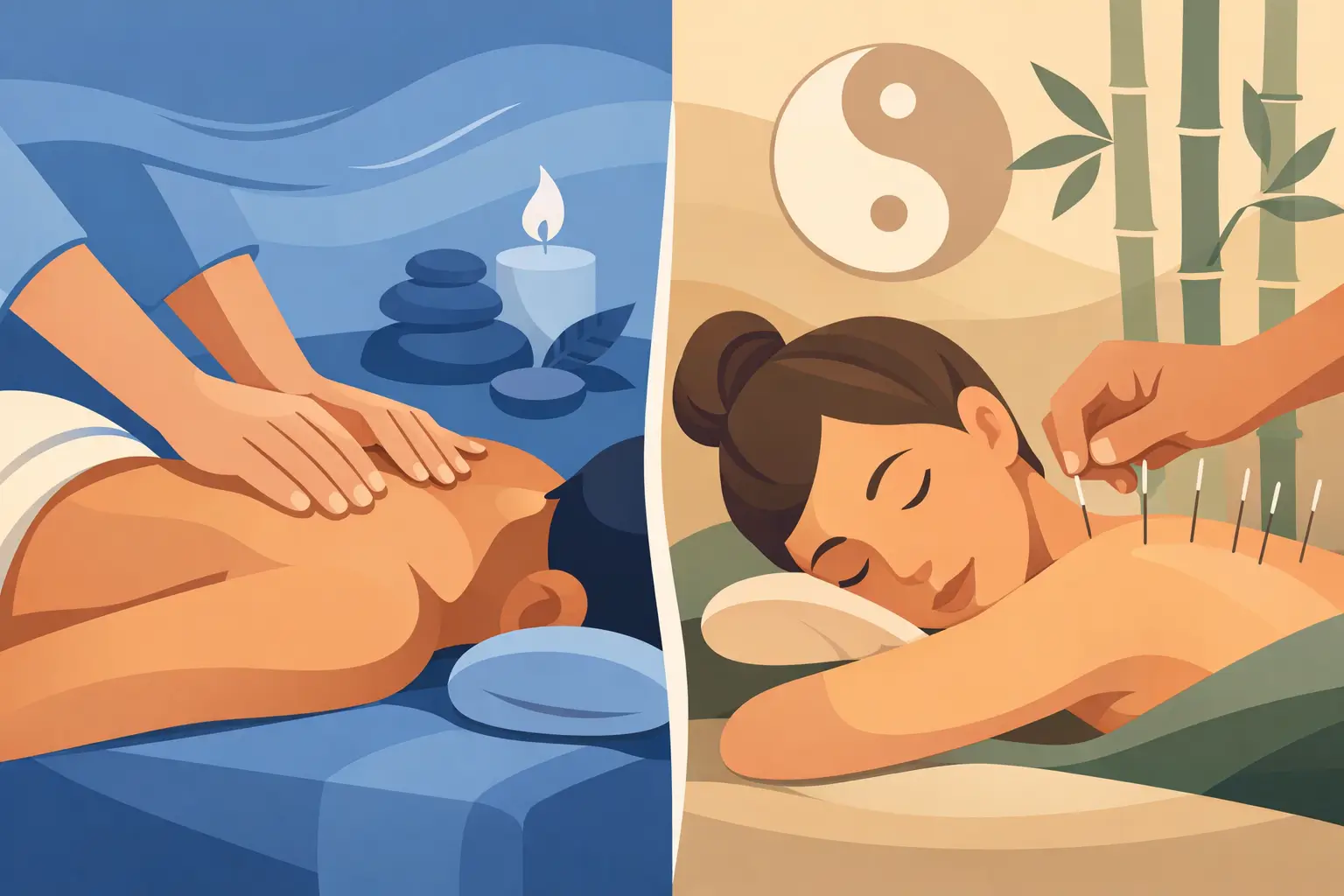
A tight neck after long hours at a desk. Low back pain that keeps flaring up. A shoulder injury that never seems fully gone. When people are weighing massage therapy versus acupuncture, they are usually not chasing trends – they want something that actually helps them move better, hurt less, and get back to normal life.
Both treatments are widely used for pain relief, recovery, and stress reduction, but they work in different ways. One uses hands-on soft tissue treatment. The other uses thin needles placed at specific points in the body. Neither is automatically better for every person or every condition. The right choice depends on what is driving your symptoms, how your body responds to treatment, and what your larger recovery plan looks like.
Massage therapy versus acupuncture: what is the real difference?
Massage therapy focuses primarily on muscles, fascia, circulation, and movement quality. A registered massage therapist uses techniques such as pressure, stretching, and targeted soft tissue work to reduce tension, improve mobility, and help calm irritated tissues. For many patients, massage feels intuitive because they can directly sense a tight area being worked on.
Acupuncture takes a different approach. It involves inserting very fine needles into specific points to influence pain signaling, tissue healing, circulation, and nervous system activity. Depending on the provider and treatment style, acupuncture may be used from a traditional framework, a modern medical framework, or a blend of both. In a musculoskeletal setting, it is often used to reduce pain, relax stubborn muscle guarding, and support recovery.
The practical difference is this: massage therapy tends to be especially useful when soft tissue restriction and mechanical tension are major parts of the problem, while acupuncture can be very effective when pain sensitivity, inflammation, muscle guarding, or nervous system involvement are significant factors. Of course, many cases involve both.
When massage therapy may be the better fit
Massage therapy is often a strong option for people who feel stiff, tight, overworked, or restricted in specific muscle groups. If your upper traps are constantly tense, your hips feel locked up, or your calves are sore after training, hands-on treatment can bring clear and immediate feedback. You may notice better range of motion, less tension, and easier movement right after a session.
It can also be helpful during injury recovery, especially when tissues are healing but compensation patterns have built up around the injury. Someone recovering from a shoulder strain, for example, may develop tightness through the chest, upper back, and neck. Massage can help reduce that secondary tension so the body is not fighting itself.
Stress is another reason people lean toward massage. Pain and stress often reinforce each other. When the body stays in a guarded, tense state, symptoms tend to linger. Massage can help shift the nervous system toward relaxation, which may reduce both pain intensity and the sense of physical overwhelm.
That said, massage is not always ideal when an area is highly inflamed, very sensitive to pressure, or difficult to access manually. Some patients also find that deep pressure feels too intense when they are already flared up.
When acupuncture may be the better fit
Acupuncture can be a good match when pain is persistent, diffuse, or linked to a more reactive nervous system. Patients with chronic neck pain, headaches, low back pain, sciatica-like symptoms, or stubborn muscle guarding often respond well. It may also help when tissue irritation is present but aggressive hands-on work would be too much.
One reason acupuncture stands out is that it can influence pain without requiring broad pressure across a painful area. For someone with an acute spasm or a highly sensitive trigger point, that can matter. The treatment may help settle the area while still supporting circulation and relaxation.
Acupuncture is also commonly chosen by patients who want a low-force option. If you do not enjoy deep tissue work or you tend to feel sore after manual therapy, acupuncture may feel more manageable. While many people are nervous about needles at first, the needles used are far thinner than the ones used for injections, and most patients describe the sensation as mild and brief.
Still, acupuncture is not the best fit for everyone. Some people strongly prefer hands-on care. Others are uncomfortable with needles despite understanding the potential benefit. Preference matters more than many people think, because consistency is easier when you feel at ease with the treatment.
Massage therapy versus acupuncture for common conditions
For everyday muscle tension, postural strain, and workout-related soreness, massage therapy often has the edge because it directly addresses soft tissue tightness and movement restriction. You can feel where the tissue is bound up, and the therapist can treat those areas in a focused way.
For headaches, jaw tension, and stress-related muscle guarding, either treatment may help. Massage can release overloaded muscles in the neck, shoulders, and jaw. Acupuncture may be especially useful when tension is part of a broader pain pattern involving the nervous system.
For chronic low back pain, the answer is often not either-or. Some patients improve more with massage because the issue is largely muscular and mechanical. Others do better with acupuncture because pain sensitivity and guarding are major drivers. In many cases, a combination produces the best result.
For sports injuries, both can play important roles depending on the stage of healing. Early on, acupuncture may help calm pain and reduce protective tension. As recovery progresses, massage can help restore mobility, improve tissue quality, and address compensation patterns.
For anxiety-related tension and general stress relief, massage is often the first choice because the experience itself is physically calming and familiar. Acupuncture can also be very effective here, particularly for patients who feel stuck in a constant state of tension and poor recovery.
What results should you realistically expect?
A good treatment should do more than create a temporary nice feeling. The real question is whether it helps you function better between visits. Are you sleeping more comfortably? Turning your head more easily? Getting through a workday with less pain? Returning to activity with more confidence?
Massage therapy may provide faster subjective relief for obvious tightness and stiffness. Acupuncture may create a more subtle response at first, especially in chronic cases, but that does not mean it is less effective. Some patients notice the benefit after one session. Others improve gradually over a short course of care.
Neither treatment should be presented as a miracle fix. If your pain is being driven by poor movement patterns, repetitive strain, untreated joint dysfunction, weakness, or an incomplete recovery plan, passive treatment alone may not hold. This is where integrated care matters.
Why the best answer is sometimes both
The strongest treatment plans are built around the person, not around a single technique. A patient with shoulder pain might need acupuncture to reduce guarding, massage therapy to improve tissue mobility, and corrective exercise to keep the problem from returning. Someone with recurring low back pain might benefit from manual treatment, mobility work, and a closer look at work posture or training load.
That is one reason many patients do well in a multidisciplinary clinic setting. Instead of forcing massage therapy versus acupuncture into a winner-takes-all decision, the care team can match the treatment to the stage of recovery and the root cause of the problem. At Pulse Health, that kind of coordinated approach matters because pain relief is only part of the goal. The bigger goal is lasting function.
How to choose between massage therapy and acupuncture
If your symptoms feel muscular, tight, and movement-related, massage therapy is often a sensible place to start. If your pain is stubborn, sensitive, hard to calm down, or not responding well to pressure-based work, acupuncture may be the better first step.
If you are unsure, think about what your body has responded to before. Deep pressure helpful? Massage may fit. Too sore after manual work? Acupuncture may be worth trying. If your condition is complex, recent, or keeps recurring, an assessment can help clarify whether the issue is mostly soft tissue, nerve-related, joint-related, or a combination.
It is also worth considering logistics and consistency. The best treatment is not just the one that sounds effective on paper. It is the one you are comfortable receiving, can fit into your schedule, and can continue long enough to see real change.
Pain care is rarely about picking the single perfect modality. It is about choosing the right tool for the problem in front of you, then adjusting as your body improves. If you are deciding between massage therapy and acupuncture, the most helpful next step is not guessing – it is getting a treatment plan that matches your symptoms, your goals, and how you want to feel a few weeks from now.